AI Automation for a Five-Person Company: What Pays Back in a Month
Three AI automations that pay for themselves within a month in a five-person company, two that never will, and the test that tells them apart before you spend anything.
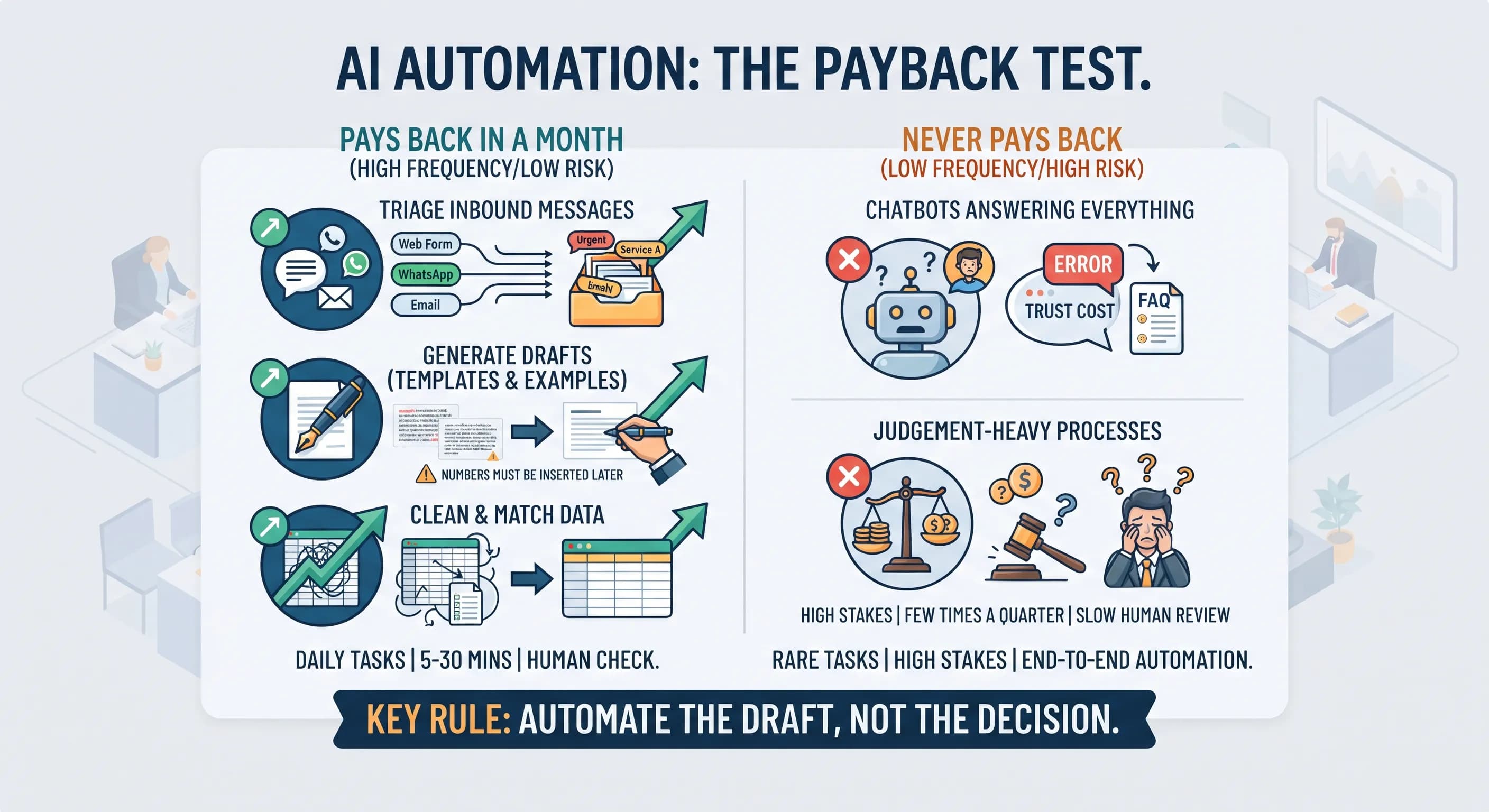
You have five people. One of them is also doing the bookkeeping, another answers every WhatsApp message that comes in, and nobody gets to the job you actually hired them for. Then you read that AI will save your team hours a week, you try a chatbot for an afternoon, and you quietly give up on it.
AI automation for a small company does work, but only on a narrow class of jobs. Three of them usually pay for themselves within a month. Two of them, including the one most companies try first, never do. Here is how we tell them apart before anyone spends money.
The test: how often, how long, and who catches it when it is wrong
Before you look at a single tool, score the task on three things.
Frequency. How many times a week does somebody do this? Daily is good. A few times a quarter is almost never worth building for.
Minutes. How long does one pass take? Under thirty seconds and the overhead of a system eats the saving. Five to thirty minutes is the sweet spot.
Cost of being wrong. Who reads the output before it matters? If a person checks it anyway, a mistake costs ten seconds. If it goes straight to a customer, a mistake costs trust.
The jobs that pay back are frequent, a few minutes long, and produce something a human glances at before it counts. That last condition is the one people skip, and it is the one that decides whether the project survives month two.
Automate the draft, not the decision.
1. Turning inbound messages into a triaged list
Enquiries arrive in four places: a web form, WhatsApp, a shared inbox, and somebody's personal number. Every morning a person reads all of them, works out which are real, and copies the useful ones somewhere. The reading is the part worth automating.
What we build: each new message goes to a model with your own instructions and comes back as structured fields. What they are asking for, which of your services it maps to, how urgent it sounds, whether they mentioned a budget, and a two-line summary. Those land in a sheet or your CRM, newest first. Nobody gets replied to automatically.
It pays back because it is the same work every single day, a human reads the output within the hour, and the worst failure is a mis-sorted row that takes ten seconds to drag. Two days of setup, then it runs without anyone thinking about it.
2. First drafts of the things you already write to a template
Quotes, follow-up emails, invoice reminders, job adverts, the post that goes out with a new case study. You write these constantly, and every one of them starts from a blank page. The blank page is the slow part, not the typing.
The trick is to feed the model ten of your own past examples rather than a paragraph describing your tone. It copies what it can see far better than what it is told. The person who always wrote these then edits a draft instead of starting one, which is a different kind of tired at the end of the day.
One rule, and it is not optional: numbers never come from the model. Prices, discounts, dates, account details and quantities get inserted from your sheet or your system after the text is generated. A model that invents a price is not a small bug.
3. Cleaning and matching the data you already have
Most small companies are sitting on a mess nobody has time to fix. One supplier whose name is spelled six ways. A couple of hundred duplicate customers. Product descriptions pasted in from three different catalogues. A folder of supplier receipts that somebody types into a spreadsheet by hand, one line at a time.
This is the one place where automation beats a person on accuracy as well as speed, because the work is tedious and a tired human makes more mistakes on hour three than on hour one. It is also the easiest to verify. Run the model, then run a plain, boring check behind it: receipt totals must equal the sum of their lines, every matched customer must share a phone number or an email. Anything that fails the check goes to a human queue instead of into your database.
A one-off cleanup is about a week of calendar time and then it is finished. It is the cheapest AI project most companies will ever run, and the only one with a definite end date.
Two AI automations for a small company that never pay back
The chatbot that answers anything
This is the first thing almost everyone tries, and it fails the test on all three axes. It talks straight to customers, so a wrong answer costs you trust instead of ten seconds. It needs a body of accurate written answers that most five-person companies simply do not have yet. And it never finishes: every price change, new service and policy means going back to check what it says.
Unless you are fielding hundreds of repeat questions a day, the honest version is a short FAQ page written by a human and an autoresponder that states your hours and promises a reply. That costs an afternoon and it never embarrasses you in front of a customer.
The agent that runs a judgement-heavy process end to end
Choosing a supplier. Setting a price. Shortlisting candidates. These are exactly the tasks a founder most wants to hand over, and exactly the ones that do not pay. They happen a few times a quarter, so there are no hours in them to save. The stakes are high enough that you will check every output in full. And checking a decision you did not make takes about as long as making it, so you have added a step and removed the thinking.
There is a third, quieter failure worth naming: automating a process nobody has written down. If two people in the company do it differently and both think they are right, no system can do it at all. Write it down first. Sometimes that alone fixes the problem and you never build anything, which is a win nobody invoices for.
What payback actually looks like at this size
We cannot tell you what you will save, but you can work it out yourself before you build. If message triage takes one person half an hour every morning, that is roughly ten hours a month. If a quote takes twenty minutes and you send five a week, a draft that is mostly right saves you most of six hours a month. Those are your numbers to measure, not ours to promise.
Against that: at these volumes, hundreds of messages a month rather than millions, model usage costs a few dollars, and the build is one to three days of somebody competent. That ratio is the whole reason these three pay back inside a month and the other two do not. It was never about how clever the model is.
What to do next
Keep a log for one week. Every repetitive task, how many times it happened, and roughly how many minutes it took.
Pick the single row that is daily, takes more than five minutes, and ends in something written that a person reads afterwards.
Build the smallest possible version: one input, one output, no interface. A spreadsheet is a perfectly good interface.
Run it beside the human for two weeks and keep a tally of corrections. If the corrections are not dropping, stop. The task was the wrong shape, not the tool.
Only then pick the next one. One at a time is slower, and it is the only version of this that sticks.
If you want a second opinion on which task to start with, or you have one of the two that never pay back half-built already, tell us what your week looks like and we will tell you which of your tasks we would automate first, and which we would leave exactly as it is.
Part of the MoyoLab team building AI-powered products and platforms for founders and growing teams.
Share this article
Related Posts
App Hosting: Four Numbers to Ask For Before You Go Live
Most founders only find out what their app hosting is worth during an outage. Ask for these four numbers first: monthly cost, backup age, time to restore, and who gets paged.
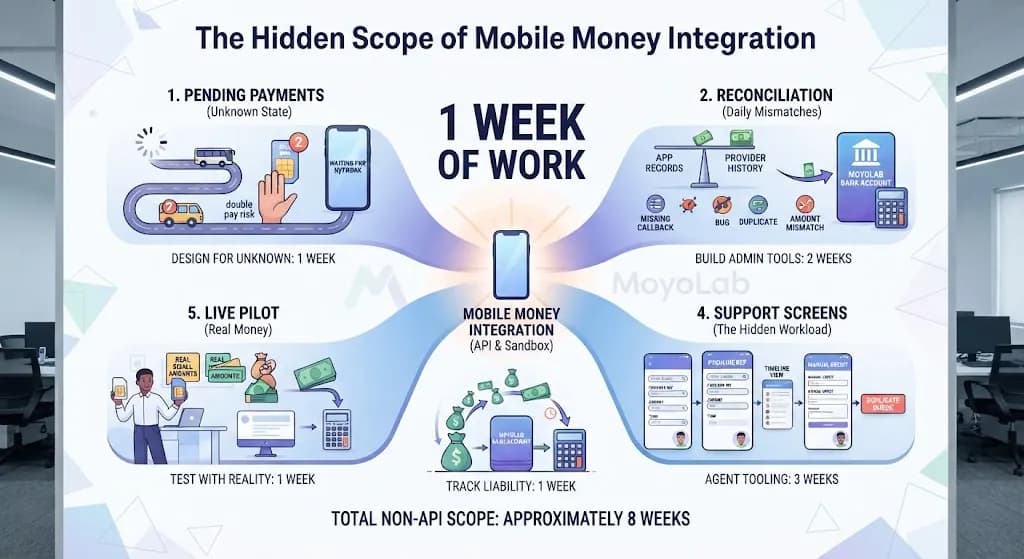
Mobile Money Integration: What Changes in Your Product, Not the API
The provider API is about a week of work. The months go into pending payments, reconciliation, retries and the support screens nobody scopes. Here is what belongs in your build plan.

What MVP Should Mean When You Have Three Months of Runway
With three months of runway, an MVP is the smallest product that proves a customer will pay. Here is what to cut, what you must keep, and how to plan the twelve weeks backwards.